



Semi-Truck Rollover Accident Lawyer: Who’s Liable When a Big Rig Tips Over in Nevada?
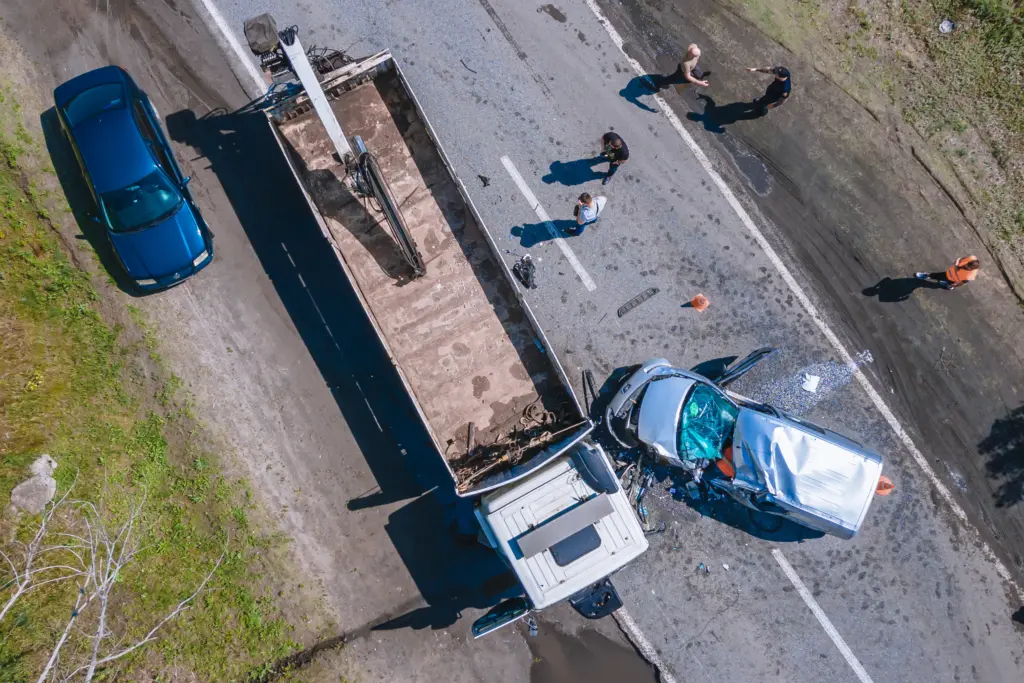
Key Takeaways
- Rollovers make up only about 4% of large-truck crashes yet drive a disproportionate share of deaths and catastrophic injuries, and Federal Motor Carrier Safety Administration data shows speed is a factor in nearly half of them.
- Liability in a Nevada semi-truck rollover often extends beyond the driver to the motor carrier, the cargo loader, the parts manufacturer, and sometimes the road owner: each one a separate insurance policy your case can reach.
- Under NRS 41.141, you can still recover damages even if you were partially at fault, as long as your share of the blame is 50% or less.
A semi-truck doesn’t have to hit you head-on to destroy your car or your life. When 80,000 pounds of tractor-trailer rolls onto its side at highway speed, anything in its path (or pinned underneath it) absorbs the entire weight of the rig. Rollovers are one of the deadliest crash types on Nevada highways, and they almost never have a single, simple cause.
If you or a family member were injured in a semi-truck rollover anywhere on I-15, US-95, I-80, or any Nevada highway, the case looks different from a routine Nevada truck accident. The chain of liability stretches further, the catastrophic injury rate is higher, and a closely related jackknife sometimes precedes the tip when the trailer swings out before the rig goes over. Richard Harris Law Firm has handled semi-truck cases across Nevada since 1980, and our consultations are always free.
Can I Sue if a Semi-Truck Rolled Over and Caused My Crash?
Yes. If a semi-truck rolled over and injured you in Nevada, you can sue any party whose negligence contributed to the crash: the driver, the trucking company, the cargo loader, a parts manufacturer, or even a road owner. Nevada follows modified comparative negligence under NRS 41.141, so you can recover damages as long as you were 50% or less at fault, with your award reduced by your share of the blame.
Why Semi-Truck Rollovers Are Different from Other Crashes
Rollovers are different because the physics are different. A loaded tractor-trailer carries its weight up high (the cargo box sits five feet above the road) and that high center of gravity is what makes the rig prone to tipping when the driver brakes hard, takes a curve too fast, or hits a road shoulder at speed. Federal Motor Carrier Safety Administration (FMCSA) data shows rollovers are the first harmful event in only about 4% of large-truck crashes, but they account for a disproportionate share of the resulting fatalities and catastrophic injuries.
Rollovers also fall into two technical categories that matter for your case:
- Tripped rollovers: The truck’s tires hit something (a curb, a soft shoulder, a guardrail, debris, another vehicle) and the impact tips the rig over. These are the more common type and often involve a separate negligent act that “tripped” the truck.
- Untripped rollovers: The truck rolls without striking anything: pure physics from speed, steering input, and load distribution. These typically point to driver error or improperly loaded cargo.
Knowing which type of rollover you were involved in helps your attorney trace the chain of liability. On Nevada’s mountain stretches (think I-80 climbing toward Donner Pass west of Reno, or US-95 climbing into Goldfield) untripped rollovers from speed and grade are more common. On urban interchanges like the Spaghetti Bowl in Las Vegas, tripped rollovers from sudden lane changes and cut-offs dominate.
Common Causes of Semi-Truck Rollover Accidents
Most semi-truck rollovers trace to forces the driver cannot outmuscle. Speed contributes to roughly 45% of truck rollover crashes; a semi taking a curve at even 5 mph above its rated speed can lose stability, especially on Nevada’s freeway off-ramps and mountain grades. Improperly loaded cargo runs a close second. Cargo that shifts mid-trip, is loaded too high, or sits unevenly across the trailer can change the truck’s center of gravity in seconds, and FMCSA research links over three-quarters of cargo-tank rollovers (fuel, milk, chemicals) to driver error or loading mistakes. Box trailers, tankers, and car haulers all carry their loads high to begin with, and strong crosswinds on I-15 north of Las Vegas can finish the job even when the driver is doing everything right.
The driver-state causes show up next. Federal regulations prohibit handheld phone use by commercial drivers, but eating, dispatch tablets, and GPS lookups still pull eyes off the road: a two-second glance at 65 mph covers 190 feet, more than enough to drift a wheel onto a soft shoulder. Fatigue is a parallel risk. Federal hours-of-service rules cap driving at 11 hours per shift within a 14-hour on-duty window, with mandatory 10 hours off and a 30-minute break after 8 hours of driving, and reaction time collapses fast when carriers push past those limits or drivers falsify electronic logs. A trucker under the influence of drugs or alcohol is a danger to every other vehicle on the road, which is why federal regulations require post-crash testing; the results often become central evidence.
The last category is the truck itself. Worn brakes, bald tires, faulty steering linkage, and broken suspension components all show up as rollover root causes, and federal regulations require pre-trip and post-trip inspections that leave a documentary trail your lawyer can subpoena. When the part itself is defective, the manufacturer can share liability under product-liability law, and tire blowouts, brake assembly failures, and steering-component defects from faulty equipment can roll a truck even with a careful driver behind the wheel.
Proving Negligence in a Nevada Semi-Truck Rollover
Proving fault in a rollover case means showing that the truck driver, the carrier, or another responsible party failed a duty they owed to you. Nevada’s traffic statutes give your attorney several anchor points. Following too closely violates Nevada Revised Statutes (NRS) 484B.127, and unsafe driving for conditions can support a negligence claim or a negligence-per-se argument when a statute was clearly broken.
Under NRS 41.141, Nevada uses modified comparative negligence: you can still recover damages if you were partially at fault, as long as your share is 50% or less. Your recovery is reduced by your percentage of blame. Trucking defense lawyers will work hard to push that percentage up, which is why the evidence you gather in the first weeks matters so much.
The evidence that wins rollover cases is rarely on the surface. Modern semis carry several data sources your lawyer can preserve through a written spoliation letter (a formal demand that the carrier not destroy records):
- Engine control modules (ECMs): Often called “black boxes,” these record speed, braking, throttle position, and steering input in the seconds before the crash.
- Electronic logging devices: ELDs automatically record hours of service and can prove a driver violated federal rest rules.
- Dash cameras and forward-facing video: Most modern fleets run cameras; the footage either confirms or contradicts the driver’s version.
- Maintenance and inspection records: Federal regulations require carriers to keep these; gaps or fabricated entries are powerful evidence of negligence.
- Accident reconstruction: An expert can use skid marks, yaw marks, and the final resting position of the truck to calculate speed and steering input at the moment of the rollover.
Who Can Be Held Liable in a Semi-Truck Rollover?
Rollover cases routinely involve more than one defendant, and that is good news for your recovery: each defendant carries a separate insurance policy. The most common liable parties are:
- The truck driver: When speeding, distraction, fatigue, impairment, or steering error caused the rollover, the driver’s personal liability is the starting point.
- The motor carrier (trucking company): Carriers are liable for their own negligence (poor maintenance, hiring an unqualified driver, pressuring drivers past hours-of-service limits) and are also vicariously liable for the negligent acts of drivers acting within the scope of employment. Federal interstate carriers must carry $750,000 to $5 million in liability coverage depending on cargo.
- The cargo loader or shipper: When uneven loading, overloading, or unsecured cargo caused the trailer to tip, the third-party loading company can be held liable separately from the carrier.
- The parts manufacturer: When a defective tire, brake, or steering component contributed to the rollover, the manufacturer faces strict product-liability exposure.
- The road owner or maintenance contractor: When a poorly designed curve, missing guardrail, or unrepaired road defect contributed to the crash, the Nevada Department of Transportation (NDOT) or its contractor can sometimes be named, subject to the special notice rules that apply to government claims.
Naming the right defendants on the right lines of the complaint is what wins a rollover case, and the liability framework is rarely the same twice.

Common Injuries from Semi-Truck Rollover Crashes
Rollover crashes produce some of the most catastrophic injuries in motor vehicle law. The combination of mass, height, and the way occupants get tossed inside (or ejected from) the rolling vehicle drives the severity. Traumatic brain injury (TBI) sits at the top of the list, both as a leading cause of death in rollover crashes and as the most common source of long-term disability among survivors. Memory, mood, and motor control can all be permanently affected, and a serious TBI claim often runs to the high seven figures or more once lifetime care is priced in. Spinal cord injuries run alongside; crush forces and ejection cause vertebral fractures and spinal cord damage that can result in partial or complete paralysis, and lifetime medical costs for a serious spinal injury frequently exceed several million dollars.
Crush injuries and amputations are the next tier. When a passenger vehicle ends up under or beside a rolled trailer, limbs are often the first to absorb the load, and surgical amputation is sometimes the only option to prevent infection or save the patient’s life. Internal organ damage is the quieter danger. Liver, spleen, kidney, and lung injuries are common in rollovers and can be deceptively easy to miss at the scene; internal bleeding kills if it isn’t caught and treated within hours, which is why a same-day ER evaluation matters even when nothing looks dramatic.
Severe whiplash and neck injuries round out the list. The forceful back-and-forth motion in a rollover causes more severe cervical injuries than a typical rear-end crash, and chronic neck pain is one of the most common long-term complaints from rollover survivors who initially walked away with what felt like minor stiffness.
Hurt in a Semi-Truck Rollover? Richard Harris Law Firm Can Help
Semi-truck rollover cases are not the kind of claim insurance adjusters settle quickly or fairly on their own. The carrier’s lawyers will argue you contributed to the crash, the cargo loader will point at the carrier, and the parts manufacturer will deny everything. Untangling that fight takes a firm with the resources to subpoena ECM data, depose carrier executives, and hire the accident-reconstruction experts these cases require.
Richard Harris Law Firm has been representing semi-truck crash victims across Nevada since 1980, from the I-15 corridor through Henderson and Las Vegas to the I-80 stretch through Reno and Sparks. We work on contingency, which means no upfront fees and you pay nothing unless we recover for you. Focus on healing. We will handle the rest.
Frequently Asked Questions
Can I Sue if a Semi-Truck Rolled Over and Hit My Vehicle?
Yes. If a semi-truck rolled over and injured you in Nevada, you can sue any party whose negligence contributed to the crash: the driver, the trucking company, the cargo loader, a parts manufacturer, or sometimes the road owner. Nevada follows modified comparative negligence under NRS 41.141, so you can recover even if you were partially at fault, as long as your share is 50% or less.
What Causes Most Semi-Truck Rollovers?
Speed is the leading cause and contributes to roughly 45% of truck rollover crashes, according to FMCSA-cited research. Improperly loaded or shifting cargo is the second-largest factor, especially in cargo-tank rollovers, where over three-quarters of crashes involve driver or loading error. Other major causes include distracted driving, fatigue, defective tires or brakes, and crosswinds on high-profile trailers.
Is the Truck Driver Always at Fault When a Semi-Truck Rolls Over?
No. While driver error is the most common single cause, rollover cases routinely involve multiple liable parties. The trucking company can be liable for poor maintenance or hours-of-service violations; a third-party cargo loader can be liable for shifting or unsecured loads; a parts manufacturer can be liable for defective tires, brakes, or steering components. Each defendant carries separate insurance, which increases what your case can recover.
Who Can Be Held Liable in a Semi-Truck Rollover Accident?
Five parties are most commonly named: the truck driver, the motor carrier (trucking company), a third-party cargo loader, a parts manufacturer, and sometimes the road owner or maintenance contractor (subject to special government-claim notice rules). Federal interstate carriers must carry $750,000 to $5 million in liability coverage depending on cargo, which sets the floor for what is collectable from the carrier alone.
What Is a Semi-Truck Rollover Settlement Worth in Nevada?
Rollover settlements vary widely with the severity of injuries, the number of liable defendants, and the strength of the evidence. Cases involving traumatic brain injury, spinal cord damage, or wrongful death routinely settle in the high six figures to multi-million-dollar range, especially when multiple insurance policies are in play. Punitive damages may also apply under NRS 42.005 when the carrier acted with oppression, fraud, or malice (for example, knowingly dispatching a fatigued or impaired driver). Past results do not guarantee future outcomes.